Before White Friday: The One-Week Call Tally for Saudi Online Stores
Before the November sale season, write down every call your store receives for one ordinary week and sort each one by what it would take to answer it. That single sheet tells you more about how your phone line will behave on White Friday than any forecast, because a sale does not invent new kinds of calls. It multiplies the ones you already get.
This guide is from Modern Intelligent Solutions, which builds Arabic-first AI voice agents for businesses in Saudi Arabia and the Gulf, including merchants on Salla and Zid. It is written for the owner or operations lead of a Saudi online store where the phone on the desk is also the customer service department. The method below costs nothing, needs no software, and is worth running whether or not you ever buy an agent from anyone.
Why the phone is the part of the store nobody prepares
Most season preparation goes into the storefront, and almost none goes into the phone line. Banners get designed, discount codes get tested, stock gets counted. The number printed in the footer gets no plan at all.
Yet the phone is where a sale puts the most pressure on a small team. The same two or three people who pack orders are the ones who pick up. Every call that interrupts packing slows the orders that the next caller will ring about. A store can run a successful sale on the website and still spend the following week apologising on the phone.
The calls themselves are not mysterious. Saudi shoppers ring a store for a short list of reasons, and the list barely changes between a quiet week in October and the busiest week of November. What changes is how many arrive at once. That is why a quiet week is the right time to measure.
The ALLO one-week call tally
For seven days, log every inbound call on one sheet with four columns: the day and rough time, what the caller wanted in their own words, whether someone answered, and which of the three shelves below the call belongs on. Include the calls nobody picked up. Your phone's call log shows them, and they are part of the picture.
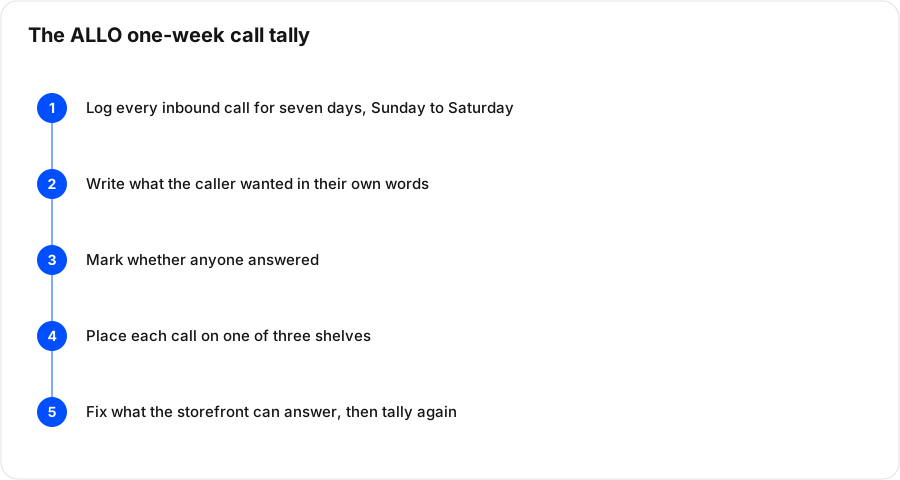
Run it across a full Saudi week, Sunday through Saturday, so that the weekend is in the sample. Do not tidy the caller's wording. "وين طلبي" and "متى يوصل" are the same question, and you want to see how often it is asked, in which words, and at what hour.
The sorting is the whole method. Do not sort calls by topic. Sort them by what a person would need in front of them to give a correct answer.
Shelf one: calls answered from a page
A shelf-one call can be answered correctly by someone reading from a single page of facts about your store. Nothing about the individual customer is needed.
These are questions such as which cities you ship to, how long delivery usually takes, whether you accept cash on delivery, whether instalment options such as Tabby or Tamara are available, what the return window is, whether a discount code works with items already on sale, and whether you have a physical branch. The answer is the same for every caller.
Shelf one is the easiest to underestimate, because each call is short. During a sale it grows quickly, because every offer you publish creates its own questions about terms.
Shelf two: calls answered from the order
A shelf-two call can only be answered by looking at that customer's order. The caller wants to know where their parcel is, wants to change the delivery address or the district, wants to add an item, wants to cancel before shipping, or wants to know why a payment was deducted twice.
No page of general facts answers these. Someone has to open the order in the Salla or Zid dashboard, or the courier's tracking page, and read from it. These calls take longer, and they are the ones that pull a packer away from the packing table.
Shelf three: calls that need a decision
A shelf-three call needs someone with the authority to decide. The item arrived damaged. The wrong size was sent and the customer needs it before a wedding on Thursday. A return falls one day outside the window. The customer is angry, and the facts are not really the point.
These are few in a normal week, and they matter more than their number suggests. A shelf-three call handled well keeps a customer. Handled badly, it becomes a public review.
What to fix before the season without buying anything
Some of what the tally shows can be fixed this month with no agent at all. Do these first, because they remove calls instead of answering them.
- Publish the answers to shelf one. If the same five questions make up most of shelf one, they belong on the product page, the cart page and the order confirmation message, in the words callers actually used.
- Write the sale terms down before the sale. Decide now whether sale items can be returned, whether codes stack, and when the offer ends, to the hour. A question your own team answers two different ways becomes a shelf-three call later.
- Send the tracking link without being asked. Many shelf-two calls come from a customer who was never told where to look. Check that your shipping notification actually carries the tracking number and a working link.
- State the shipping cut-off honestly. Couriers can get slower in a peak week. A delivery estimate that was true in October and is quietly wrong in late November generates calls for a fortnight.
- Confirm the address at checkout. A missing district or national address short code turns into a courier call, then a customer call, then a second delivery attempt.
Then run the tally for a second week. Whatever remains is the real workload for the phone.
What an AI voice agent should take, shelf by shelf
An AI voice agent earns its place on a store's phone line by taking shelf one completely, taking the first half of shelf two, and getting shelf three to a human fast. Be suspicious of anyone who promises more than that without showing it working on your store.
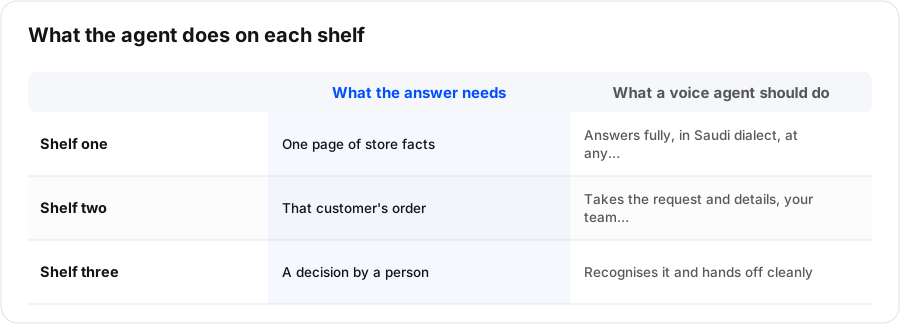
Shelf one: the agent answers. This is the work a voice agent does best. It answers in Saudi dialect at any hour, gives the same answer to the hundredth caller as to the first, and never puts anyone on hold. Its accuracy depends entirely on the page of facts you give it, which is why the sale terms need to be written down first.
Shelf two: the agent takes the request, your team finishes it. This needs honest treatment. To tell a caller where a specific parcel is, an agent must be able to read that order. Where it cannot, the correct behaviour is to collect the order number, the caller's name and exactly what they want changed, confirm it back, and pass your team a complete written request. The customer has been heard, and your packer reads a note instead of holding a phone.
For ALLO specifically: it connects to your store on Salla or Zid and reads your real orders and products — order status, shipping, catalogue, sizes and stock. So on shelf two it can tell the caller where their order is and send the tracking link, add a product to the cart, or open a return, and it hands anything that needs a person to your team with a written summary. Any vendor you speak to should be equally exact about which of the two they are offering: an agent that reads your orders, or one that takes a message.
Shelf three: the agent gets out of the way. The right behaviour is recognition and a clean handoff: transfer to a person during working hours, or a promised callback with the details already written down outside them. An agent that argues return policy with an upset customer is making the problem worse.
The season brief you give the agent or the new hire
Whoever answers the phone in November needs the same single page, whether that is an AI voice agent or a temporary team member. Write it once.
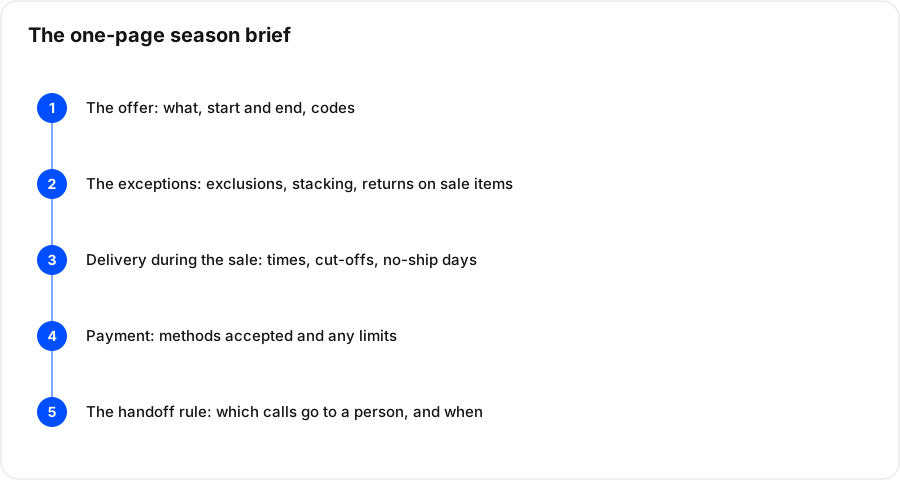
- The offer: what is discounted, the exact start and end, and which codes exist.
- The exceptions: what is excluded, whether codes combine, and whether sale items can be returned or exchanged.
- Delivery during the sale: realistic times by region, the cut-off for same-week dispatch, and which days nothing ships.
- Payment: which methods are accepted, including cash on delivery and instalments, and any limits.
- The handoff rule: exactly which situations go to a person, to whom, and at which hours.
If you cannot fill in this page, the agent cannot answer the phone correctly, and neither can a person. Many stores discover at this step that a section or two was never decided.
Run the tally again in the middle of the sale
Repeat the tally for two or three days at the peak, even roughly. Compare the shelves with your quiet-week sheet.
If shelf one has grown most, an offer is unclear and the fix is one sentence on the product page. If shelf two has grown most, dispatch or the courier is behind and customers were not told. If shelf three has grown, something is wrong with the product or the packing, and that is worth knowing by Saturday, not by the end of the month.
What this tally does not tell you
The tally measures the phone, and only the calls that reached it. It does not count the customers who messaged on WhatsApp or Instagram instead, and for many Saudi stores that is the larger channel. Run the same three-shelf sort on a week of messages if you want the full picture.
It also cannot tell you how much an unanswered call cost. You will see how many calls were missed and when. Whether each one was a lost order or a patient customer who rang back is something no sheet can show, and anyone who quotes you a precise figure for it is guessing.
Where to start
Start the sheet this Sunday. A week of honest tallying in October is enough time to fix shelf one on the storefront, write the season brief, and decide whether the phone needs help before late November. If your store already runs a cloud phone system, cloud PBX or an AI voice agent explains which of the two answers the calls your tally shows going unanswered.
If you want to see what a voice agent does with your shelf-one questions, the pages for Salla merchants and Zid merchants describe what ALLO does on a store's phone line today, including the orders and products it reads. If you are comparing vendors, run the seven-check store-agent test on each of them, and the ten-minute phone test on the Arabic itself. And if you would like to bring your tally sheet and talk it through, contact Modern Intelligent Solutions. We build for retail and e-commerce in Saudi Arabia, in the Arabic your customers speak.