The short answer: a Saudi hotel does not have to choose staff or AI for every call. Keep a one-week tally of the calls to your front desk and reservations line. Sort each call by what answering it needs and by the hour it came in. Calls that need only the hotel's own information, and that come at night or during the check-in rush, are where an AI voice agent fits. Calls that need judgement, authority or a person at the counter stay with your staff. Very often the answer is both, with the agent answering first and the front desk second.
This guide is from Modern Intelligent Solutions (حلول الذكاء الحديث), a Riyadh company that builds Arabic-first AI voice agents for Saudi businesses. The method works whoever you end up buying from, including us.
Why hotels end up asking this question
A hotel phone rings for reasons that do not follow shift times. A guest landing late wants to know whether they can still check in. A family driving in from another city asks about parking before they set off. Someone wants to move their dates. Meanwhile the person at the desk is serving the guest standing in front of them, and the night shift is usually the thinnest one.
So "staff or AI?" is the wrong question in the abstract. The useful question is: which calls should each one answer? You can only answer that with your own calls, not with someone else's averages. We will not hand you a benchmark, because we cannot check one against your hotel.
Step 1: Keep a one-week call tally
For seven days, including the weekend, log every call to the front desk and the reservations line. For each call, write down:
- the time it came in;
- what the caller wanted, in a few words;
- whether someone answered it;
- who could have answered it.
For missed calls, use your phone system's call report if it has one. If you are still choosing a phone system, our post on cloud PBX or an AI voice agent explains what each layer does. A week of your real calls tells you more than any estimate.
Step 2: Put each call on one of three shelves
Shelf 1: the answer is in the hotel's own information. Check-in and check-out times, location and directions, parking, facilities, what a stay includes, house policies, published prices.
Shelf 2: the answer needs your reservation system. Is my booking confirmed? Can I change the date or add a night? Is there a room for these dates?
Shelf 3: the answer needs a person. A complaint, a charge or refund dispute, a special arrangement, an important guest, anything that needs judgement or the authority to decide.
Step 3: Mark the hour of each call
Against each call, mark one of three times: the normal day shift, the check-in and check-out rush, or the night. Then mark the missed calls separately. Now you can see two things at once: what the calls need, and when they come.
How to read your tally
Missed calls cluster at night, and most sit on shelf 1. An AI voice agent answers these straight away, around the clock, in Saudi dialect, from the hotel's own information. A night clerk could answer them too. The real question is whether you want to staff the night for calls like these.
Missed calls cluster in the check-in rush. That is a problem of calls arriving together. A person answers one call at a time while a guest waits at the desk. The agent answers each call straight away, so the desk can stay with the guest in front of it.
Many calls sit on shelf 2. Here, be exact about what the agent needs. It can see the caller's context from the systems it is connected to, such as the record linked to their number. It makes or changes a reservation only by writing into your own reservation system through an integration. Without that integration, it takes the details and hands the case to your reservations team with a summary. That still beats a call that rings out, but plan for it honestly.
Shelf 3 dominates. Keep or hire staff. The agent's job on these calls is to answer quickly, take the details and pass the call to the right person with a summary, so the guest does not have to explain everything twice.
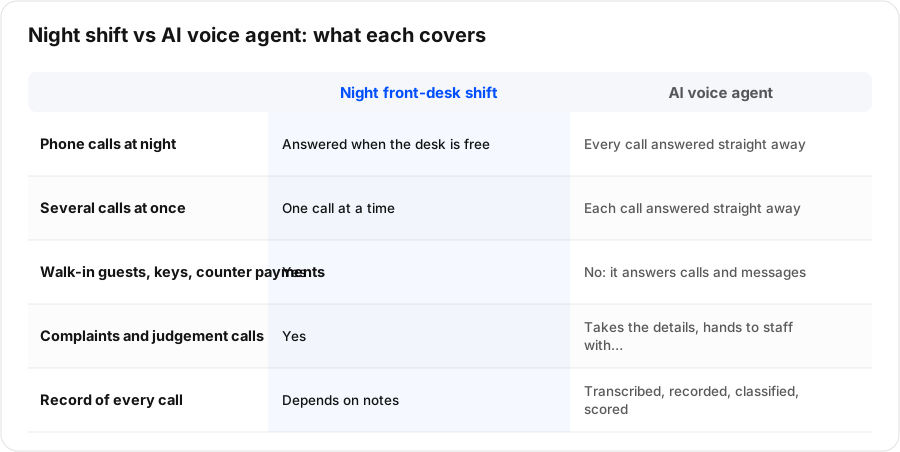
What a night front-desk shift does that an agent does not
To be straight about it: a person at the desk deals with walk-in guests, keys, payments at the counter, emergencies in the building and decisions that need authority. An AI voice agent answers calls and messages. If your night problem is the lobby rather than the phone, staff the lobby.
What an agent adds that a shift does not
- Every call answered straight away, in about 1.2 seconds, at any hour, with no "press 1, press 2" menu. If your line still runs on a menu, see our IVR-to-voice-AI migration plan.
- Calls out as well as in. It can place reminder and confirmation calls to guests and message them on WhatsApp.
- WhatsApp as a second channel, answered the same way as the phone.
- A record of every call. Each call is transcribed, recorded and classified, with a quality score and the guest's sentiment, in one dashboard. Over a few weeks you can read what guests ask, and when, without anyone keeping notes.
Questions to ask any provider before you buy
- Does it hold up in Saudi dialect? Call it the way your guests do: late, in a hurry, mid-sentence. Our guide on how to test an Arabic AI receptionist before you buy gives a test you can run.
- Where do its answers come from? They should come from your hotel's own information, which you can update when a policy or a price changes.
- How does it hand over? To which person, by which route, and with what summary?
- What does it do with reservations? Does it write into your own system through an integration, or take the details and pass them on? Both can work. You need to know which one you are buying.
- Where is the data kept? ALLO complies with the Saudi Personal Data Protection Law and keeps its data inside the Kingdom. Ask any provider the same question.
- How long until it is live? ALLO can be live within 7 days.
A layout to consider
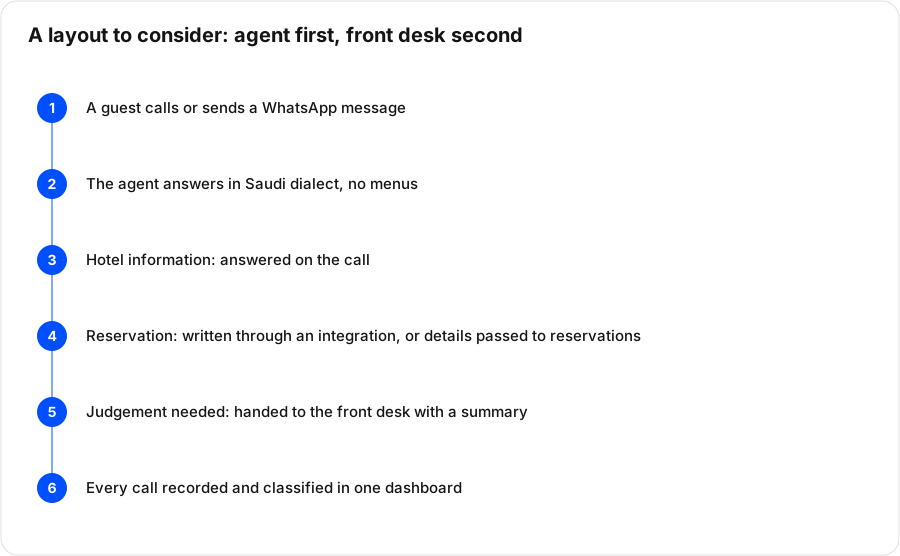
The agent answers every call and message first. It answers shelf 1 on the call. It handles shelf 2 through an integration, or passes the details to reservations. Shelf 3 goes to the front desk with a summary. Every call lands in one dashboard, so next month's tally is already done for you.
Where to start
Start the one-week tally on your next working day. It costs nothing but a few minutes per shift, and it tells you whether your gap is the night, the rush or the kind of calls you get. If you would like to go through your tally with us, get in touch. You can also see how we work with hotels and resorts.