Cloud PBX or an AI Voice Agent? The Calls a Saudi Small Business Still Misses
A cloud PBX decides where a call goes. It does not answer it. That one sentence settles most of the confusion between the two purchases. A cloud phone system gives a Saudi small business one number, extensions, working-hours rules and call reports. An AI voice agent picks up the call that would otherwise ring out, understands what the caller wants in Saudi dialect, and either answers it or takes the details for your team. If your problem is that calls land on personal mobiles, buy the PBX first. If your problem is calls that nobody picks up, the PBX is already doing its job and the gap is the answer.
This guide is from Modern Intelligent Solutions, which builds Arabic-first AI voice agents for businesses in Saudi Arabia and the Gulf. It is written for the owner or manager of a small business, such as a real-estate office, a restaurant, a salon or an online store, who is shopping for a «سنترال سحابي» or already has one. It includes a check you can run on your own call reports in under an hour, whichever product you end up buying.
What a cloud PBX actually does
A cloud PBX is a phone system that runs on a provider's servers instead of a box in your office. You get a business number, and the system routes each incoming call by rules you set.
The features most cloud PBX plans offer are similar:
- One number for the business, with extensions for each person or team.
- Ring groups, so a call rings several phones at once or in turn.
- Working-hours rules, so calls outside those hours follow a different path.
- A recorded greeting or menu ("press 1 for sales").
- Voicemail, usually sent to an email or an app.
- Call recording and a call log, showing which calls were answered and which were not.
- Mobile and desktop apps, so staff can take business calls away from the desk.
All of this is about routing and record-keeping. It is genuinely useful. A business that still gives out three staff mobile numbers gains a great deal from moving to one routed line.
What a cloud PBX cannot do
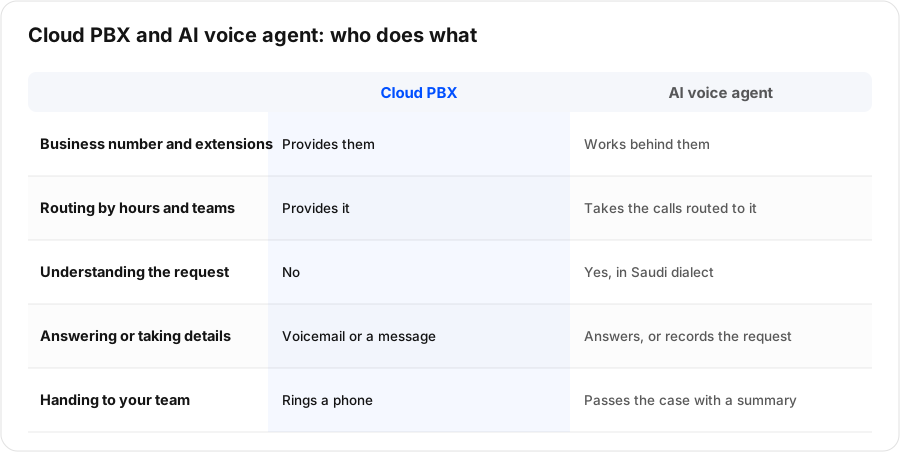
A cloud PBX cannot hold a conversation. Every rule in it ends in one of four places: a person's phone, a recorded message, a menu, or voicemail.
When the person is free, that works. When they are not, the PBX has only the other three to offer, and each of them hands the work back to someone:
- A recorded message tells the caller to try again later. The caller does the work.
- A menu sorts the caller into a queue that still needs a person at the end of it.
- Voicemail stores the call for a person to return later, usually after the caller has phoned someone else.
- Forwarding to a mobile moves the ringing phone from the desk to someone's pocket, often the owner's.
None of these understand the request. A caller who wants to know whether a flat is still available, whether there is a table at nine, or where their order is, gets the same treatment as a sales call. That is the gap an AI voice agent fills.
Where a small business misses calls
A small business misses calls at predictable moments, and they are rarely the moments the owner is thinking about. Four common patterns:
- Real-estate office. Agents are out at viewings when a listing is fresh and the phone is busiest. Callers want to know if a unit is available, the price, and when they can see it.
- Restaurant. The phone rings hardest during the lunch and dinner rush, exactly when every staff member is serving. Callers ask about bookings, delivery areas and opening hours.
- Salon. The staff's hands are busy with clients. Callers want an appointment, a price or a free slot.
- Online store. The same two or three people pack orders and answer the phone. Callers ask where their order is, about returns, and about payment options.
In each case the business is open and staffed, and the call is still missed. After-hours calls, weekend calls and calls during prayer breaks come on top of that.
The four-week missed-call check
Before you buy anything, open your current call log and measure your own numbers. If you already have a cloud PBX, its report has everything you need. If you do not, use the call history on the phones that take business calls.
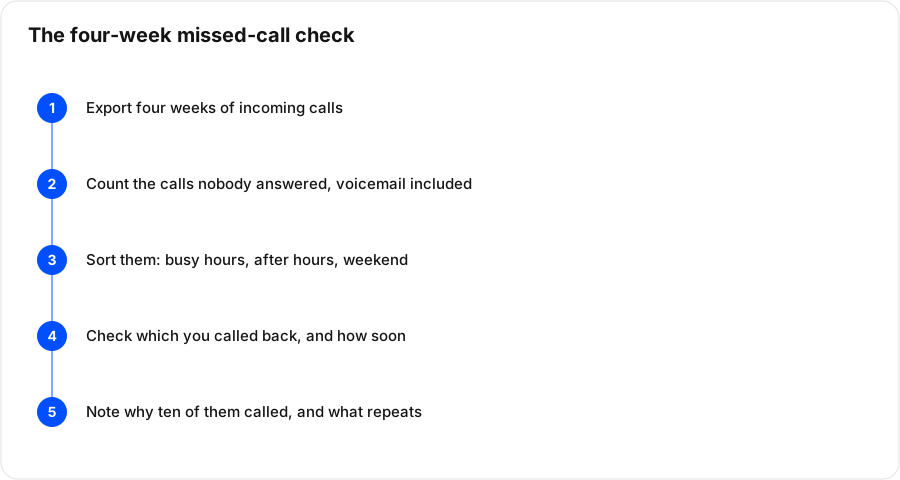
- Export four weeks of incoming calls. Four weeks covers the start and end of a month and two weekends.
- Count the calls nobody answered. Include calls that went to voicemail or that hung up in the menu.
- Sort each missed call by when it came in: during working hours while staff were busy, outside working hours, or at the weekend.
- Check how many of those numbers you called back, and how soon. Look at the gap in hours, not just whether it happened.
- Write down why ten of them were calling, if you can tell from the callback or a later message. You are looking for questions that repeat.
The check answers a buying question directly. Few missed calls, mostly in working hours, means the routing needs fixing, not a new product. Many missed calls with the same few questions behind them means you are short of someone to answer, at hours you cannot staff.
Which one to buy
Match the purchase to what the check showed, not to the product category.
- Calls go to personal mobiles and there is no business line. Start with a cloud PBX. You need one number and a call log before anything else makes sense.
- You have a PBX and the missed calls are few and in working hours. Fix the rules first: widen the ring group, shorten the time before a call moves on, and turn off menu options nobody uses.
- Missed calls cluster at rush hours, after hours or at weekends, and the same questions repeat. Add an AI voice agent behind the PBX, on the paths that currently end in voicemail or a recorded message.
- Most callers need a decision from a person, such as a price negotiation or a complaint. The agent should take the caller's details and the reason for the call, then hand it to your team, rather than try to settle it.
Most small businesses that already run a cloud PBX land in the third group. Their routing works. Their staff are simply busy at the moments the phone rings most.
How the two work together
You do not have to choose between them. The cloud PBX stays the business line and the router. The AI voice agent answers where the PBX would otherwise have sent the caller to voicemail.
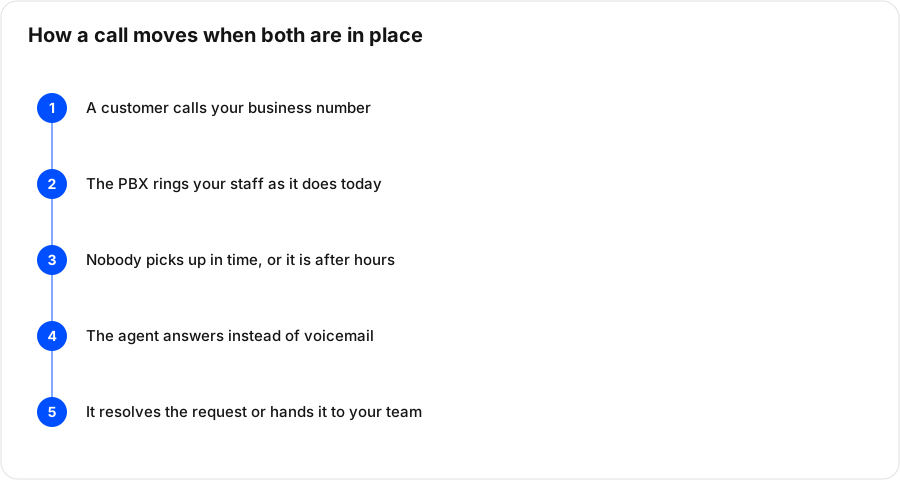
In practice, a call reaches your number and rings your staff as it does today. If nobody picks up within the time you set, or it is outside working hours, the call goes to the agent instead of to voicemail. The agent answers, understands the request and either resolves it or records what the caller needs and passes it to your team.
How calls reach the agent depends on your PBX and on the vendor. It might be forwarding of unanswered calls to a number the agent answers, or a direct connection between the two systems. Ask any vendor exactly how it will work with your current number and your current PBX before you sign, and ask to see it run on a test call.
Questions to ask before you buy either
- Where is the call data hosted, and does the setup meet the PDPL? Recordings and transcripts are personal data.
- Does it understand Saudi dialect on a real call? Test it with your own staff using your own customers' phrasing. Our step-by-step receptionist test gives you a script.
- What happens when the caller needs a person? You want the case passed to a named person or team with the details already written down, not a caller told to ring back.
- Does it keep my current number? Changing a number printed on signs, listings and delivery bags is expensive.
- What do I see after each call? A recording alone is not enough to manage from. Ask for transcripts and a reason for each call.
- What does it do at the weekend and at night? That is when a small business is least able to answer and most likely to lose the caller.
What ALLO does in this setup
ALLO is the AI voice agent from Modern Intelligent Solutions. It answers in about 1.2 seconds, 24 hours a day, and speaks native Saudi dialect. It understands what the caller wants, answers or takes the details, and hands the case to your team in one click with a summary. Every call is transcribed, classified by topic, quality-scored, sentiment-analysed, recorded and archived. Data is hosted in Saudi Arabia, the service is PDPL-compliant, and a business can be live in seven days.
For online stores on Salla or Zid, the agent connects to the store and reads real orders and products, so a "where is my order" call gets a real answer. See the Salla integration page and AI voice agents for retail. For offices that take bookings, the agent can book into the business's own booking or scheduling system through an integration; it does not replace that system. Real-estate offices can see how this applies on AI agents for real estate, and restaurants and hotels on hospitality.
What an AI voice agent will not fix
- A missing follow-up. If handed-over requests sit unread, the caller is still lost, just later.
- An unclear offer. If staff cannot answer a question about your prices or terms, an agent cannot either. Write the answers down first.
- A line nobody owns. Someone on the team must read the call reports each week and act on what repeats.
If you run an online store, our one-week call tally is a closer look at sorting store calls before the sale season. If you run a larger team with a full contact centre, read call-centre software or an AI voice agent instead.
To see how ALLO would answer your own calls, book a demo and we will run it on your business's real questions.