How to Choose an AI Customer Service Agent for a Saudi Online Store
Choose an AI customer service agent by testing it against your own store's real work, not by comparing feature lists. Most vendor pages claim the same things: Arabic support, WhatsApp, 24/7 availability. The differences that actually matter to a Saudi online store only show up when you put the agent in front of a real Saudi customer question — in the right dialect, against live order data, on the payment methods your customers actually use.
This guide gives you a testable method. It is written by Modern Intelligent Solutions, which builds Saudi-dialect AI voice, WhatsApp, and web-chat agents for businesses in Saudi Arabia and the Gulf. We sell an agent, so read the checks below as things to run on any vendor — including us. A vendor that can't pass them in a live demo won't pass them with your customers.
What an AI customer service agent does for a Saudi online store
An AI customer service agent answers your store's incoming customer messages automatically, in Arabic, at any hour. For a Saudi e-commerce store, it handles the repetitive volume that fills your inbox every day:
- Order status — "وين طلبي؟" is one of the most common messages a Saudi store receives.
- Product and stock questions — sizes, availability, specifications, restock timing.
- Returns and exchanges — walking the customer through your actual policy.
- Abandoned carts — following up with a customer who added an item and left.
- Handoff — recognizing the genuinely complex cases and passing them to a human with the conversation intact.
The goal is not to replace your support team. It is to take the repetitive majority off their plate so they spend their hours on the cases that need a person.
Why "Arabic support" on a vendor's website tells you almost nothing
Almost every vendor claims Arabic support, and almost none of them mean the same thing by it. This is the most common way a Saudi store ends up with an agent its customers dislike.
There are three meaningfully different things a vendor might be selling you:
- Machine-translated English. The agent thinks in English and translates. It reads as stiff and slightly wrong, and customers notice immediately.
- Modern Standard Arabic (MSA). Grammatically correct, formal, and nobody talks that way to a store. It reads like a government letter, not a shop assistant.
- Saudi dialect. The way your customer actually types. Even within Saudi Arabia this varies — Najdi and Hejazi speech differ, and a Riyadh customer hears the difference.
Your customers do not write to you in MSA. They write "وش الأسعار" and "المقاس متوفر؟" and send voice notes. An agent that answers formal MSA to a casual Saudi message is technically correct and commercially useless.
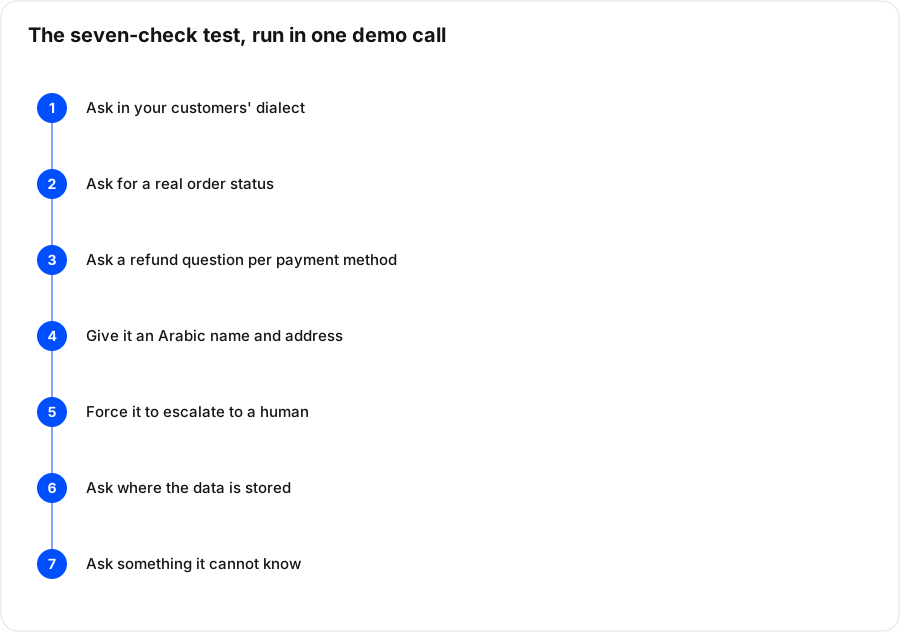
The ALLO seven-check store-agent test
Run these seven checks in a single vendor demo. Each one takes a few minutes, each targets a specific way an agent fails a Saudi store, and each has a clear pass or fail. Ask to drive the demo yourself rather than watching a scripted walkthrough.
1. The dialect check
Ask the vendor to run a live conversation in the dialect your customers actually use, not "Arabic" generally and not MSA. Type the way your customers type — short, casual, unpunctuated, mixed with English words. A capable agent answers in the same register. If the vendor offers a pre-recorded video instead of a live exchange, treat that as a fail.
2. The live-data check
Ask the agent for the status of a real order. This is the check most chatbots fail, and it is the difference between an AI agent and a scripted bot. A scripted bot matches keywords and replies from canned text — it can tell the customer how to check an order, but never where the order is. A real agent connects to your store system and answers with live data.
Ask specifically how it connects to your platform. Most Saudi stores run on Salla, Zid, Shopify, or WooCommerce, and the integration quality differs per platform. "We can integrate" is not an answer; ask whether the connection already exists and what it reads.
3. The payment-question check
Ask the agent the payment questions your customers ask. Saudi checkout is not one payment method — customers use mada, Apple Pay, STC Pay, buy-now-pay-later services like Tabby and Tamara, and cash on delivery, and they ask different questions about each one. A refund timeline question about a BNPL order is not the same answer as one about a card payment.
An agent trained on a generic global e-commerce script will answer these vaguely or wrongly. Ask it a refund question for each payment method you actually offer.
4. The Arabic name-and-address check
Give the agent a Saudi name and address in Arabic and see what it does with them. Arabic names, and Saudi address formats including the National Address system, are a known weak point for systems built for Latin-script markets. Watch for the agent mangling the name, dropping the district, or silently transliterating.
This matters beyond politeness. If the agent writes the customer record into your system, a mishandled name or address becomes a delivery failure later.
5. The escalation check
Deliberately ask something the agent cannot answer, then watch the handoff. Two things must happen: the agent has to recognize it is out of depth, and the human who picks up has to receive the full conversation, not a fresh empty chat.
The failure mode to watch for is an agent that keeps confidently answering instead of escalating. Ask the vendor how the escalation threshold is set and whether you can tune it.
6. The data-residency check
Ask where your customers' conversation data is stored and who can access it. Saudi Arabia's Personal Data Protection Law (PDPL) governs how personal data of people in the Kingdom is handled, and your store is responsible for what your vendor does with that data. Get the answer in writing.
Ask two follow-ups: whether your conversations are used to train the vendor's models, and what happens to your data if you leave.
7. The quiet-failure check
Ask the agent something it has no way of knowing — a detail absent from your catalogue or policy. The right behaviour is to say it doesn't know and offer a route to someone who does. The dangerous behaviour is a confident, plausible, invented answer.
This check is an easy one to skip, and in our experience it is the one that causes the worst incidents after go-live. An agent that invents a return window or a delivery date creates a commitment your store has to honour.
AI agent vs. hiring more support staff
The honest comparison is not "which is better" — it is which fits which job. Each is genuinely stronger at different things.
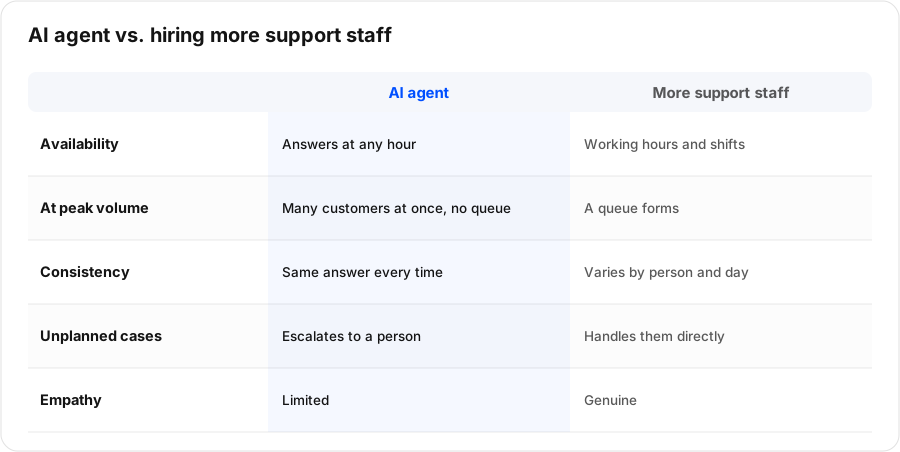
A human team brings judgement, empathy, and the ability to handle the situation nobody planned for. An AI agent brings constant availability, consistency, and the ability to answer many customers at the same moment without a queue forming. The strongest setup for most Saudi stores uses both: the agent as an always-on first line, your team as the escalation layer.
One agent across every channel your customers use
Your customers do not only use WhatsApp. They message on Instagram, open the chat widget on your store, and some still call. An agent worth buying is not a WhatsApp-only tool — it is one assistant carrying the same product knowledge and the same Saudi dialect across every channel a customer might pick.
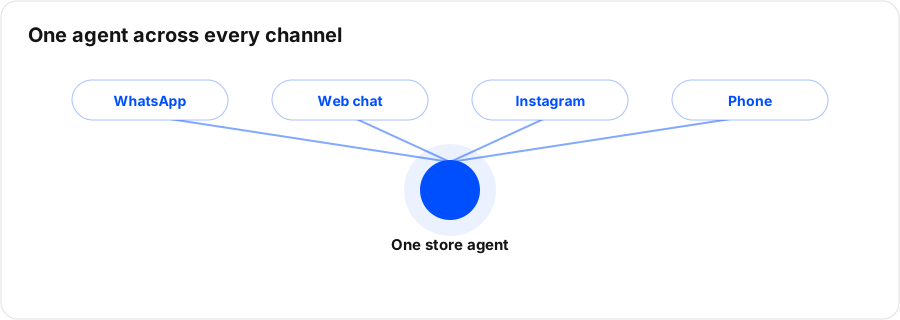
Ask any vendor whether adding a second channel means configuring a second bot with its own separate answers. If it does, you will be maintaining two sources of truth, and they will drift apart.
When you don't need an AI agent
If your store receives a handful of messages a day and one person answers them comfortably, you do not need an AI customer service agent yet. The economics only work when repetitive message volume is genuinely costing you — in staff hours, in slow replies, or in sales lost after hours.
The clearest signal that you are ready is a pattern, not a number: the same few questions arriving over and over, and customers waiting overnight for answers you could have given instantly.
What good looks like after go-live
Judge the agent on your own numbers, measured before and after. Track the share of conversations it resolves without a human, how often it escalates, and how many messages arrive outside your team's working hours. Those three tell you whether it is doing real work.
Read the escalated conversations weekly for the first month. Every escalation is either a gap in the agent's knowledge you can close, or a case that correctly belongs with a human — and you want to know which.
Getting started
Modern Intelligent Solutions builds Saudi-dialect AI agents for retail and e-commerce stores in Saudi Arabia, covering WhatsApp, web chat, and voice. If you want to see the seven checks run against a real agent, ask us to run them live.
For a deeper look at the WhatsApp side specifically — order status, stock, returns, and cart recovery — read AI WhatsApp Agents for Saudi Online Stores.
If your store also takes phone calls, run the one-week call tally before the November sale season to see which calls an agent should take and which belong with your team.