AI Voice Agents for Saudi Clinics: Answering the Booking Calls You Miss
An AI voice agent for a Saudi clinic answers the phone in Saudi dialect when your front desk cannot — books, reschedules, and confirms appointments, answers the routine questions that fill the line, and passes anything clinical straight to your staff. The problem it solves is not "we need AI." It is that a patient whose call goes unanswered books with whoever answers next, and nobody at the clinic ever finds out.
This guide is written by Modern Intelligent Solutions, which builds Arabic-first AI voice, WhatsApp, and web-chat agents for businesses in Saudi Arabia and the Gulf. It is aimed at clinic owners, medical-centre operations managers, and front-desk supervisors. It gives you a method for scoping a clinic voice deployment — starting with a number you already have and have probably never looked at.
The unanswered call is the lost appointment
A clinic's phone line fails in a specific, predictable way: it fails in bursts. Understanding that pattern is what makes voice automation worth doing, and it is why "hire another receptionist" rarely fixes it.
Your front desk is not idle when it misses a call. It is checking in the patient standing in front of it, taking payment, or on the other line. Calls do not arrive evenly through the day — they cluster at opening, around the end of the working day, after clinic hours, and on the day after a weekend or a public holiday. A receptionist is a fixed capacity meeting a spiky demand curve, so the peaks overflow no matter how good the person is.
What makes it expensive is that the overflow is invisible. A missed call leaves no record in your calendar, no complaint, and no ticket. The patient does not call back and wait — they call the next clinic on the map, and that clinic answers. The appointment was never lost at the front desk; it was lost in a queue nobody could see.
An AI voice agent changes one thing here: the phone is always answered, in the caller's own dialect, on the first ring, at 11pm and at 8am. Everything else in this guide is about deciding what it should be allowed to say when it does.
Start with a number you already have: the ALLO missed-call week
Before you evaluate a single vendor, run the ALLO missed-call week — a one-week audit of your own phone system that turns "we should do something about the phones" into a scoped list of intents.
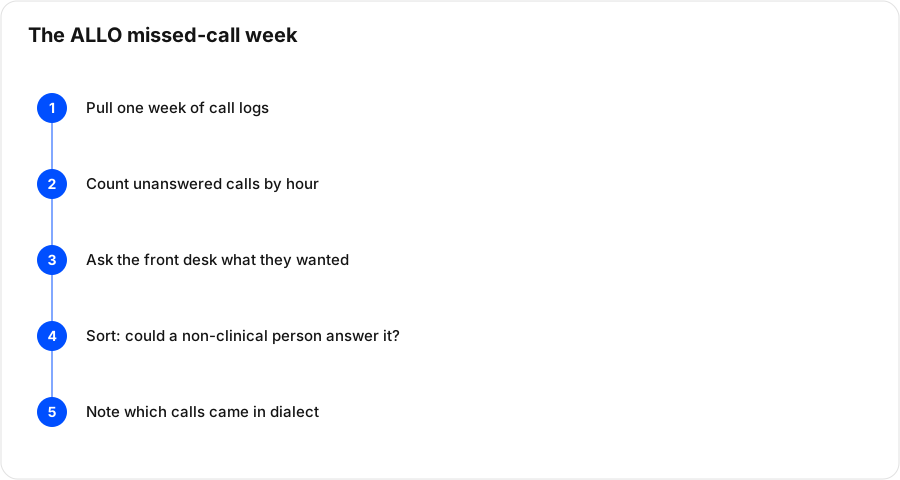
It takes one person about an hour, and it works whether you are on a PBX, a cloud phone system, or a mobile number:
- Pull one week of call logs. Every inbound call, with its timestamp and whether it was answered.
- Count the unanswered ones and plot them by hour. You are looking for the shape of the spikes, not the total. Most clinics find a morning peak and a long after-hours tail.
- Ask the front desk what those callers wanted. They already know. Write down the top five reasons in plain language — booking, rescheduling, "are you open," directions and parking, preparation instructions before a procedure.
- Split those five into: could a well-briefed non-clinical person answer this? That question, not a technology question, is what separates an automatable intent from one that must reach a human.
- Note which calls came in Arabic dialect versus English. This sets your quality bar for every demo you sit through afterwards.
At the end of the week you have the two things any honest scoping conversation needs: how much demand your phone line is dropping, and exactly which requests make it up. Run it on any vendor's promise, including ours.
Which clinic calls to automate — and which must always reach a person
The scope decision in healthcare is sharper than in most sectors, because the line between an administrative question and a clinical one is not negotiable. Sort every call reason into three bands and hold the third band absolutely.
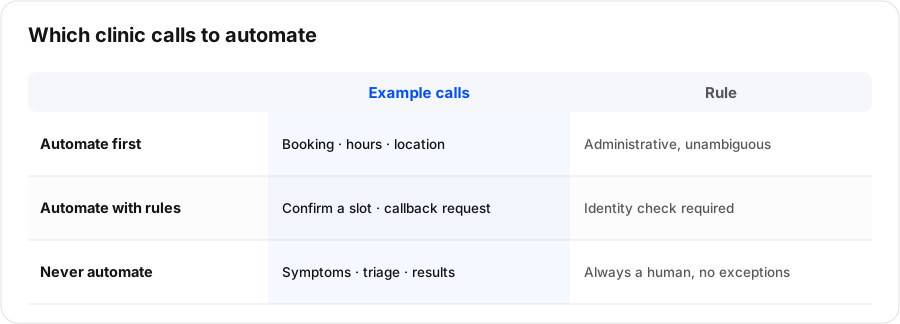
- Automate first — administrative, high volume, unambiguous. Booking, rescheduling, and cancelling appointments. Opening hours, location, parking, and which entrance. Which doctors practise which specialty and when. Whether a clinic accepts a given insurer. Pre-visit preparation instructions your clinicians have already written down, read back exactly as approved.
- Automate with verification and rules — patient-specific but still administrative. Confirming an existing appointment, telling a patient their booked slot, taking a callback request for a results enquiry, or routing a refill request into the workflow your clinical staff already use. These need identity checks and a clear policy about what may be said aloud on a phone line.
- Never automate — anything clinical. Symptoms, advice, triage, urgency assessment, test results, dosage, and anything that sounds like an emergency. The agent's job here is to recognise the intent in the first sentence, stop, and get a human on the call — or direct the caller to emergency services where that is the right answer. Automating the intake of a clinical call is acceptable. Automating the judgement is not, ever.
The band that decides whether patients trust the system is the third one. An agent that cheerfully attempts a symptom question has failed even if it happens to say something reasonable, and one bad instance travels further than a hundred smooth bookings.
Saudi dialect is what keeps a patient on the line
Patients decide whether to keep talking or hang up within the first sentence, and they decide it on how the voice sounds — not on what it can do.
Most Saudi patients call in local dialect, not Modern Standard Arabic. A clinic line that answers in textbook MSA sounds like an announcement, not a person, and the caller's instinct is to press zero or hang up and try the clinic down the road. This matters more in healthcare than in retail: the caller is often unwell, often calling on behalf of a parent or a child, and has less patience for a system that makes them repeat themselves.
Three things separate an agent that sounds native from one that does not:
- Dialect coverage. Najdi, Hijazi, and Eastern Province speech differ audibly, and a caller notices immediately when the register is wrong.
- Code-switching. Saudi callers move between Arabic and English inside one sentence — a specialty name, a doctor's name, a date. The agent cannot stumble when they do.
- Names, dates, and spoken numbers. Arabic personal names, national ID and file numbers, and appointment times spoken aloud in dialect, with Arabic and Western digits mixed. This is quietly where most clinic calls succeed or fail, because almost every call ends in a name and a time.
When you evaluate any vendor, including us, insist on a live call in the dialect your patients actually speak, with a real Arabic name and a real appointment time — not a recorded demo and not "Arabic" in the abstract.
Reminders and rescheduling are where no-shows get addressed
No-shows are a scheduling problem before they are a patient-behaviour problem, and the lever is not a louder reminder. It is making the reschedule easier than the no-show.
A reminder that only informs gives the patient nothing to do with the information. If they cannot make Tuesday, and changing it means calling during working hours and waiting in the same queue that failed them earlier, the path of least resistance is to simply not attend — and the slot dies with no chance of being refilled. A reminder that lets the patient act, by voice or on WhatsApp, converts a would-be no-show into a freed slot you can still fill.
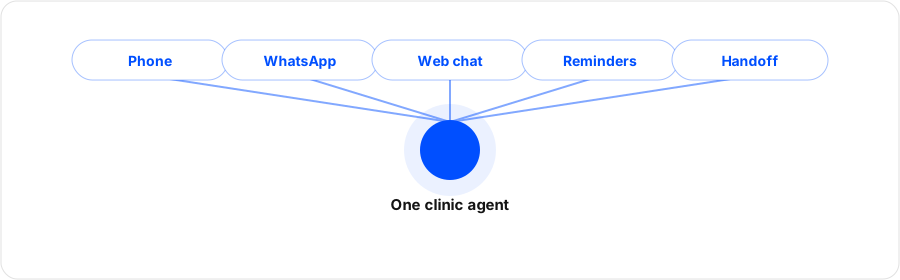
Design the follow-up loop around three rules:
- Every reminder carries an action. Confirm, reschedule, or cancel — in the same conversation, in Arabic, without a callback.
- A freed slot goes back into circulation. A cancellation two days out is only a win if someone can be offered the slot.
- The channel follows the patient. Some patients answer the phone, others only read WhatsApp. Reaching them where they respond is a bigger factor than the wording of the message.
We do not publish no-show reduction figures, because the honest answer is that the number depends on your specialty, your patient mix, and how far ahead you book. Measure your own baseline before you launch and you will have a real figure — yours.
Patient data and PDPL: settle this before scope
For a clinic, how patient information is handled is not a feature comparison. It is the precondition, and it should be agreed before anyone discusses which intents to automate.
Saudi Arabia's Personal Data Protection Law (PDPL) sets expectations for how personal data is handled and where it resides, and health information is among the most sensitive category any business holds. Call recordings, transcripts, patient names, and appointment details all fall inside that perimeter. Routing them through a generic public AI service with no residency or audit guarantees is not a defensible position for a medical centre. Modern Intelligent Solutions builds for this reality: PDPL-minded deployment, in-Kingdom data-residency options, and controls your administration can actually own.
Four questions to settle in writing, before scope:
- Where does the data live? Recordings, transcripts, and patient details — stored and processed where. In-Kingdom is the safe default.
- Who can hear and read it? Access enforced by role, not by trust, and revocable when staff change.
- What is the agent allowed to say out loud? A governed set of approved answers, not an open-ended model improvising about a patient's care.
- What is retained, and for how long? Including recordings, and including what happens when a patient asks.
None of this is an argument against voice automation on a clinic line. It is the specification it has to be built against from day one.
How to measure a clinic voice agent
Measure the thing the agent was hired to fix. For a clinic that is answered demand and filled slots — not call volume, and not a satisfaction score in the abstract.
- Answer rate, including out of hours. The share of inbound calls that got a response at all. This is the baseline the ALLO missed-call week gives you for free.
- Bookings and reschedules completed by the agent. Appointments actually written into the calendar without staff time.
- Escalation accuracy. Of the calls that should have reached a human — every clinical one — how many did. This number should be perfect, and it is the one to audit by listening, not by dashboard.
- No-show rate on reminded appointments versus your own pre-launch baseline. Yours, measured, not a vendor's.
- Front-desk interruption. Whether your receptionists are finishing conversations with the patient in front of them.
Watch them by call reason, not in aggregate. A strong overall containment number can hide one intent the agent handles badly — and in a clinic, that one intent might be the one that matters most.
One clinic, or a group
The same agent covers both, but the centre of gravity moves.
For a single clinic whose problem is the appointment book, almost all the value sits in the first two bands: answer the call, book or move the appointment, and send the reminder that lets the patient act. One number, one calendar, one set of rules.
For a group or a hospital, where the phone line, WhatsApp and the website all have to behave the same way and be governed as one, the work shifts to consistency — the same policy on every channel and every branch, the same escalation path to your staff, and one place a supervisor can see what happened on any call. That is a configuration difference, not a different product.
Where to start
If you run a clinic or a medical centre in Saudi Arabia, the first move costs nothing and does not involve a vendor: run the ALLO missed-call week on your own phone logs. You will know how many patients you are handing to the clinic down the road, and exactly which five questions they were calling to ask.
To see how this maps to your organisation, read our overview of AI agents for healthcare and clinics in Saudi Arabia. If you are comparing vendors, our guide to choosing an AI customer service agent covers the checks worth running in any demo, and migrating from IVR to a voice agent covers what changes on the phone system itself. Once you have a shortlist, the ten-minute phone test is how you check the Arabic itself before you sign.
Modern Intelligent Solutions builds Arabic-first AI voice agents for businesses across Saudi Arabia and the Gulf. The audit above works on any vendor — including us. An agent that cannot pass it in scoping will not pass it with your patients.