The Lead Response Audit: Five Numbers to Measure Before You Buy an AI Sales Agent
Before you evaluate a single AI sales agent, spend an afternoon in your own CRM and call log and come out with five numbers. They tell you whether an AI sales agent would earn its cost at your company, and they tell you which of its capabilities you actually need. Without them you are buying on a vendor's claim rather than on your own pipeline.
This guide is from Modern Intelligent Solutions (حلول الذكاء الحديث), which builds Arabic-first AI agents — voice, WhatsApp and web chat — for companies in Saudi Arabia and the Gulf. It is written for sales directors, commercial managers and contact-centre owners evaluating an AI agent for lead response, and the audit works on any vendor, including us.
Why this audit exists instead of a benchmark table
Nearly every page you will read on AI sales agents opens with the same borrowed figures: how many hours the average B2B team takes to respond, how much conversion improves if you call within a minute, what share of deals goes to whoever replies first.
We are deliberately not repeating those numbers, for two reasons.
The first is that we cannot verify them. They circulate between vendor blogs with the original study rarely named, and some trace back to research conducted years ago on Western B2B web-form leads.
The second matters more: they describe a sales motion that is not yours. Those benchmarks assume leads arrive by web form during a Monday-to-Friday week. In Saudi Arabia, the working week runs Sunday to Thursday, a large share of inbound enquiries arrive on WhatsApp rather than a form, the day is punctuated by prayer times, and a lead who answers the phone expects to be spoken to in Saudi dialect. A benchmark built on a different week, a different channel and a different language cannot tell you what your gap is.
Your own five numbers can. Every one of them is already sitting in your CRM or your telephony reports.
The five numbers
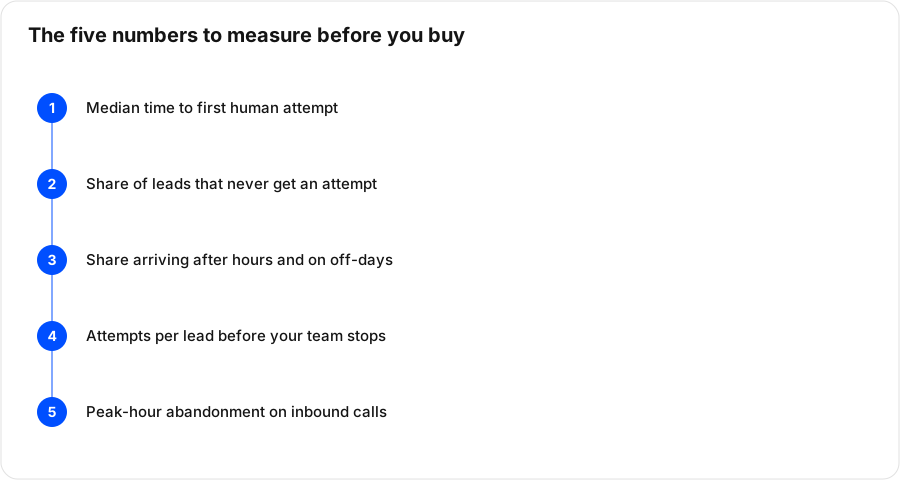
1. Median time from lead arriving to first human attempt
Pull every inbound lead from the last full month. For each one, the time it arrived and the time someone first tried to call it. Take the median, not the average.
The median matters because averages hide exactly the problem you are looking for. One lead called back in two minutes and one called back three days later average out to something that looks survivable; the median tells you what actually happens to a typical lead.
Measure this per source if you can. Leads from a paid campaign, an organic form and a WhatsApp enquiry usually sit in different places in the queue, and the worst of the three is where an agent pays for itself first.
2. The share of leads that never get an attempt at all
Count the leads with no logged call attempt within 24 hours, as a percentage of all leads.
This is the number most companies are surprised by, because it does not feel like a failure in the way a lost deal does — nobody reports it, and it leaves no trace in the pipeline. Leads that arrive in a busy week, during a campaign spike, or while two reps are on leave quietly age out.
If this number is large, speed is not your real problem. Coverage is. That changes what you should buy: you need something that attempts every lead, not something that attempts the same leads faster.
3. The after-hours and off-day share
Count the share of leads that arrive outside your team's working hours. Include the Friday–Saturday weekend, evenings, and the gaps around prayer times when the floor is empty.
Then look at what happens to those leads on the next working morning — are they first in the queue, or behind everything that arrived during the night?
This is the number that most often makes the case for a voice agent on its own, and it is specific to how your market behaves rather than to any benchmark. A real-estate office taking enquiries on a Friday afternoon and a B2B supplier whose buyers only enquire during office hours will get very different answers here, and should buy different things.
4. Attempts per lead before your team gives up
For leads that did get called, count how many attempts were logged before the record went quiet.
A lead that was called once, did not answer, and was never tried again is not a lost lead — it is an unworked one. Multi-attempt follow-up is the least glamorous part of lead response and the first thing to collapse under load, because it feels unproductive while it is happening.
Look at where the drop-off sits. If most records stop at one attempt, the agent capability you need is persistence and scheduled retries, not conversational sophistication.
5. Peak-hour abandonment on inbound calls
From your telephony reports, take the share of inbound calls abandoned in queue during your busiest hour, and compare it to your daily average.
This is the inbound mirror of the first four numbers. A caller who hangs up waiting was a lead who tried to reach you and failed, and in most reporting they are invisible — they never become a record, so they never show up as a loss.
If your peak-hour abandonment is far above your daily average, your constraint is concurrency: you do not need faster agents, you need more lines answered at once than a human floor can cover.
What an AI voice agent changes, number by number
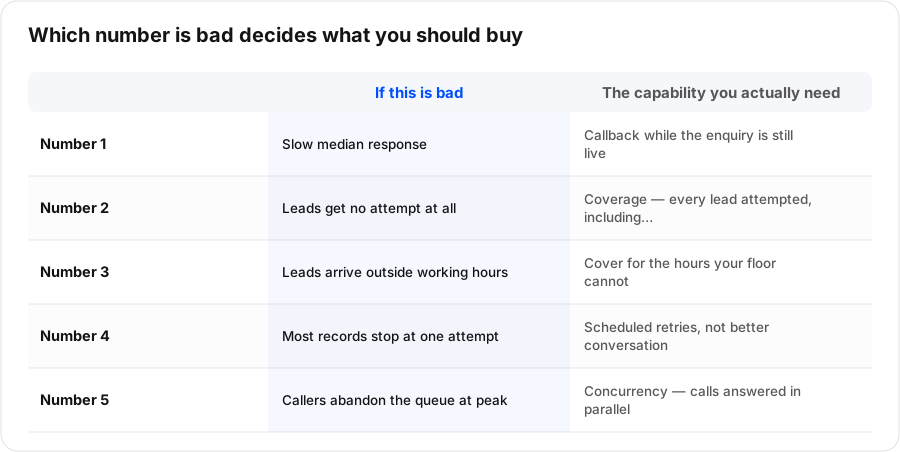
An honest answer here is "different things depending on which number is bad," which is the whole reason to measure first.
If number 1 is bad (slow median), an agent calls a new lead back while the enquiry is still live, in the minutes after it arrives rather than the next time a rep clears their queue.
If number 2 is bad (coverage), this is where an agent changes the most, because the constraint is capacity rather than skill. Every lead gets an attempt, including the ones that arrive in a spike.
If number 3 is bad (after-hours), the agent covers the hours your floor cannot, and the relevant question becomes what it is allowed to do at 11pm — book a meeting, qualify and schedule a human callback, or simply take details well.
If number 4 is bad (single-attempt), the agent keeps a retry schedule without anyone deciding to make the fourth call.
If number 5 is bad (peak abandonment), the agent takes calls in parallel at peak, which a human floor can only do by hiring for a peak it does not have all day.
What it does not change: your close rate on qualified, contacted leads. If your five numbers are all healthy and you are still not closing, the problem is further down the funnel and an AI sales agent is the wrong purchase. Say so to any vendor who tells you otherwise.
What to require from a vendor once you know your numbers
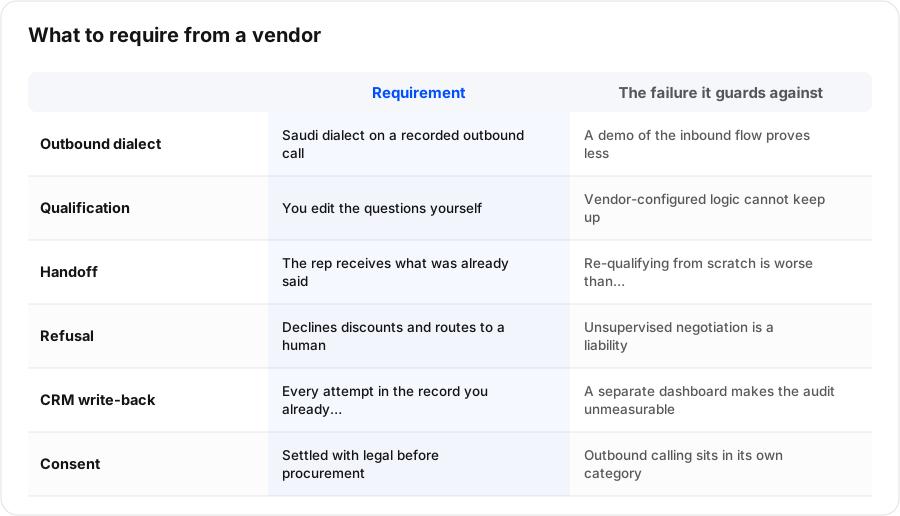
Saudi dialect on an outbound call, not just an inbound one. This is a harder test than it sounds and it is worth being specific about why. On an inbound call the customer has chosen to ring you and will tolerate a stilted first sentence. On an outbound call the agent opens the conversation with someone who did not initiate it, and anything that sounds like a recording ends the call in the first few seconds. Ask to hear a recorded outbound call in Saudi dialect, not a demo of the inbound flow.
Qualification you control. You should be able to state the questions that decide whether a lead is worth a human's time, and change them without going back to the vendor. If qualification logic is something they configure for you on request, assume it will not keep up with your campaigns.
A clean handoff with context. When the agent passes a lead to a closer, the rep should receive what was already said. The failure to look for is the lead being re-qualified from scratch by a human asking the same three questions — which is worse than no agent, because the lead has now answered them twice.
Honest refusal. Ask what happens when a lead asks for a discount, a custom contract term, or a commitment on delivery. The answer you want is that the agent declines and routes to a human. An agent that negotiates price unsupervised is a liability, not a feature.
CRM write-back you can audit. Every attempt, outcome and transcript in the same record your team already works from. If the agent's activity lives in a separate dashboard, your five numbers become unmeasurable the moment it goes live — and you will want to re-run this audit afterwards.
Consent and outbound calling obligations. Outbound calling to leads carries regulatory weight in Saudi Arabia, and it sits in a different category from answering a call someone placed to you. Establish with your own legal or compliance function what consent your lead sources actually capture before you automate outbound contact, and expect your vendor to support whatever that answer requires — including in-Kingdom data residency where your policy calls for it. This is a question to settle before procurement, not after.
Re-run the audit sixty days after you deploy
The five numbers are a baseline, not a one-time exercise. Measure them again two months in, from the same reports.
This is the step most deployments skip, and skipping it is how a project ends up defended on anecdote — a good call someone remembers, a deal that happened to close. Your median response time, coverage and peak abandonment either moved or they did not, and those are the numbers that justify the spend.
If the agent is working, numbers 2, 3 and 5 should move first and most, because capacity is what an agent adds. Number 1 should follow. Your close rate on contacted leads should be roughly unchanged — if it fell, the agent is qualifying badly and passing the wrong leads through, which is worth catching at sixty days rather than at renewal.
Where to start
If you only have time to measure one number, measure the second — the share of leads that never get an attempt. It is the fastest to pull, it is the one most companies have never looked at, and it is the one where an agent makes the largest difference.
We build Arabic-first AI voice agents for Saudi and Gulf companies, and the audit above is the first conversation we would rather have than a demo. If you want to walk through your five numbers with us — or you have run them and want to know whether voice is the right answer for the one that looks worst — talk to us on WhatsApp or get in touch.
More on the operational side of this: moving a contact centre from IVR to voice AI, how to test an Arabic AI receptionist before you buy it, and our work with real-estate offices and bank and fintech contact centres.