AI Voice Agents for Saudi Bank Contact Centers: A Practical Guide
An AI voice agent for a Saudi bank contact center answers inbound calls in Saudi dialect, resolves the high-volume routine intents that flood the queue, and hands every sensitive or regulated call to a human specialist with the full context attached. The hard part is not the technology. It is deciding which calls a machine should ever take, keeping the data inside the Kingdom, and proving to your risk and compliance teams that every interaction is traceable.
This guide is written by Modern Intelligent Solutions, which builds Arabic-first AI voice, WhatsApp, and web-chat agents for enterprises and government in Saudi Arabia and the Gulf. It is aimed at contact-center, operations, and digital leaders at banks and fintechs. It gives you a method for scoping a voice deployment, not a feature list — because the difference between a voice agent your callers trust and one they fight to escape shows up in the design decisions below, long before any vendor's demo.
What an AI voice agent does in a bank contact center
An AI voice agent is a system that answers a phone call, understands what the caller wants in spoken Arabic, and either resolves the request or routes it to the right person. In a Saudi bank contact center, it sits in front of — or fully replaces — the traditional IVR menu.
Instead of "press 1 for balances, press 2 for cards," the caller simply says what they need, in the dialect they actually speak. The ALLO voice agent from Modern Intelligent Solutions then handles the request end to end for routine intents:
- It identifies the intent — a balance question, a card issue, a branch location — from natural speech, not a menu tree.
- It answers within your rules — reading only the approved response your compliance team signed off on.
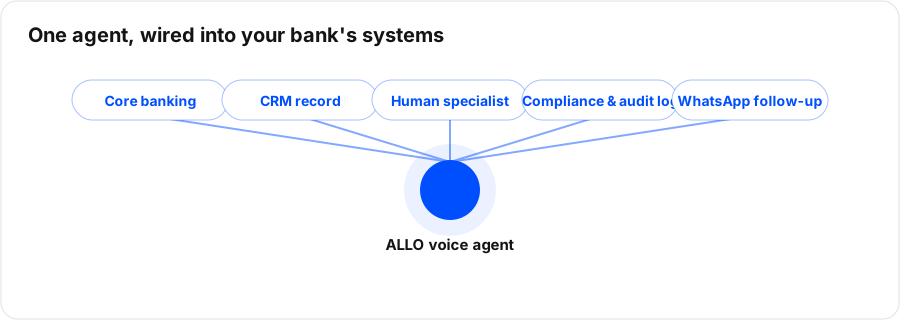
- It acts where you allow it — checking a status, confirming a payment date, sending a WhatsApp follow-up.
- It escalates cleanly — recognizing the calls that must reach a human and transferring them with the conversation intact.
The goal is not to remove people from banking. It is to take the repetitive, low-risk majority of calls off the queue so your specialists spend their time on the disputes, fraud, and complex cases that genuinely need a person.
Which banking calls to automate first — and which to never automate
The single most important decision in a bank voice deployment is scope: which call types the agent is allowed to handle alone, and which it must always pass to a human. Get this right and callers trust the agent. Get it wrong and one mishandled dispute becomes a conduct problem.
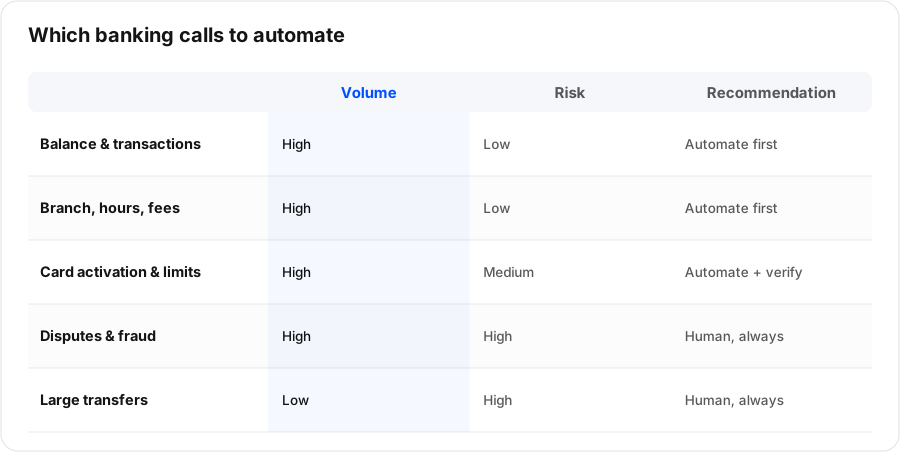
Score every high-volume call type on two axes only: how often it happens and how much risk a wrong answer carries. High-volume, low-risk intents are where automation pays off first. High-risk intents belong with a person, every time, no matter how common they are.
The pattern is consistent across Saudi retail banks and fintechs:
- Automate first — high volume, low risk. Balance and transaction inquiries, branch and ATM locations, working hours, product and fee information, and payment or due-date reminders. These are the same handful of questions asked thousands of times, and a correct answer is unambiguous.
- Automate with verification — high volume, medium risk. Card activation, temporary card block, limit checks, and statement requests. The agent can handle these once identity is verified through the step-up flow your risk team defines.
- Never automate — high risk. Disputes, suspected fraud, large transfers, account closures, and hardship or complaint cases. The agent's job here is to recognize the intent instantly, reassure the caller, and warm-transfer to a specialist with a full summary. Automating the intake is fine; automating the decision is not.
The named method: run the ALLO five-call-type audit. Pull your contact center's top call reasons for the last quarter, sort them into those three bands, and you have your automation roadmap and your escalation rules in one page — before you talk to any vendor.
Why Saudi dialect quality decides whether callers trust the agent
Callers judge a voice agent in the first sentence, and they judge it on dialect. This is the make-or-break factor for Arabic voice in the Gulf, and it is where most generic platforms quietly fail.
The majority of Saudi and Gulf callers speak in local dialect, not Modern Standard Arabic. When a bank's voice agent answers in textbook MSA, the interaction feels like reading a government circular aloud — correct, formal, and immediately artificial. The caller senses a machine and starts pressing 0 for a human.
Three things separate a voice agent that sounds native from one that does not:
- Dialect coverage. Najdi, Hijazi, and Eastern Province speech differ, and a Riyadh caller hears the difference. The agent has to understand and respond in the register the caller used.
- Code-switching. Saudi callers move between Arabic and English mid-sentence — "أبي أفعّل الـ card." The agent cannot break when they do.
- Spoken numbers and terms. Account numbers, amounts, and banking vocabulary spoken aloud, in dialect, with Arabic and Western digits mixed. This is where accuracy quietly decides whether the whole call works.
When you evaluate any vendor, including us, insist on a live call in the dialect your callers actually use — not a recorded demo, and not "Arabic" in the abstract.
Human handoff is a feature, not a fallback
In banking, the escalation path is not the part that happens when the agent fails. It is a core part of the design, and regulated buyers should evaluate it as carefully as the automation itself.
A good handoff carries the whole journey with it. When the ALLO agent transfers a caller to a specialist, the specialist receives who the caller is, what they asked, what was verified, and what has happened so far — so the human opens with the answer, not with "please say that again." A cold transfer that drops the context is worse than no automation, because the caller has now told their story twice.
Design the handoff around three rules:
- Escalate on intent, not just on failure. The moment the agent detects a dispute, a fraud signal, or distress, it should route to a human — even if it technically could have continued.
- Carry the context. Identity, verification status, and the full interaction summary move with the call.
- Log the seam. The point of handoff is exactly what auditors and complaint reviewers will want to see later.
Compliance and data residency for regulated buyers
For a Saudi bank, where the call data lives and how the interaction is governed are procurement requirements, not features. This is the layer that decides whether a voice deployment is even permissible, and it should be settled before scope.
Saudi Arabia's Personal Data Protection Law (PDPL) sets expectations around how personal data is handled and where it resides, and banks operate under the Saudi Central Bank's (SAMA) supervision on top of it. Regulated financial data generally should not flow through generic public AI systems with no residency or audit guarantees. Modern Intelligent Solutions builds for this reality: PDPL-minded deployment, in-Kingdom data residency, and the enterprise controls your compliance team can own.
Four things your compliance and risk teams will ask about — and should:
- Data residency. Where call recordings, transcripts, and personal data are stored and processed. In-Kingdom is the safe default for regulated buyers.
- Auditability. A defensible line from the caller's intent through every step to the handoff, retrievable for disputes and audits.
- Access control. Who and what can see customer data, enforced by role, not by trust.
- Approved answers only. The agent says what your disclosure policy permits and nothing more — its response set is governed, not open-ended.
None of this is a reason to avoid voice automation. It is the specification the automation has to be built against from the start.
How to measure a banking voice agent
You cannot manage a voice deployment you do not measure, and the metrics that matter are about containment and quality, not call count. Define these before you launch so week one has a baseline.
- Containment (deflection) rate. The share of calls the agent fully resolves without a human. This is the headline efficiency number.
- Escalation accuracy. Of the calls that should have gone to a human, how many did — and how few good automations were escalated unnecessarily.
- Average handle time. For both the agent and the humans it hands off to, since good handoffs shorten the human call.
- First-contact resolution. Whether the caller's issue was actually solved, not just ended.
- Caller satisfaction. Measured on the intents you automate, in the callers' language.
Watch these by call type, not just in aggregate. A high overall containment rate can hide a specific intent the agent handles badly — and in banking, that one intent might be the one that matters.
A staged rollout, not a switch
Deploy a bank voice agent the way you would any change to a regulated customer channel: one narrow intent at a time, measured before it is expanded.
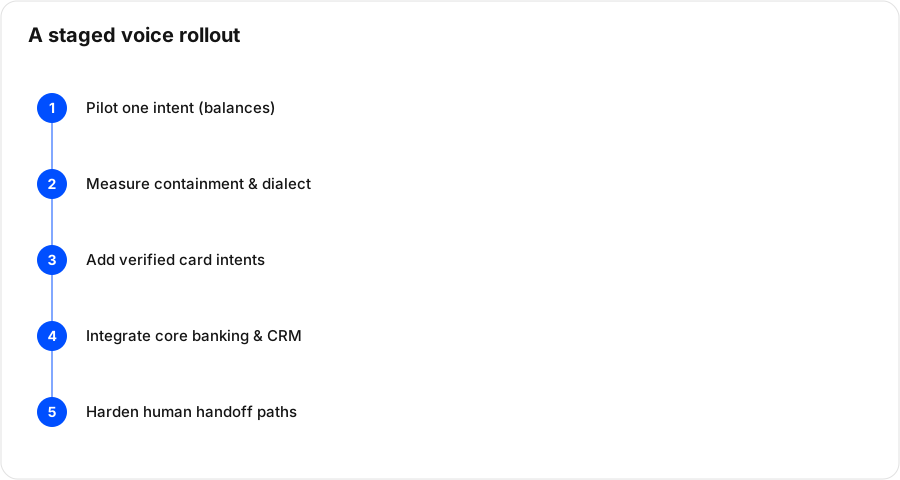
Start with a single high-volume, low-risk intent — balance inquiries are the classic first step. Prove the containment and dialect quality on that one intent with real callers. Then widen the scope one band at a time, wiring in verification for the medium-risk intents and hardening the escalation paths for everything you have deliberately left with humans. Integrate with your core banking and CRM systems as the scope grows, so the agent acts on live data and every interaction lands in the record your teams already use.
The banks that succeed with voice AI treat it as an operations program with a compliance spine, not a product they switch on. Scope tightly, measure honestly, and let the audit trail carry the proof.
Where to start
If you run a contact center at a Saudi bank or fintech, the first move costs nothing: run the ALLO five-call-type audit on last quarter's call reasons and you will know exactly which intents are ready for voice automation and which must stay with your specialists.
To see how this maps to your organization, read our overview of AI agents for fintech and digital banks in Saudi Arabia, or — if you are still comparing vendors — our guide to choosing an AI customer service agent and the checks to run in any demo.
Modern Intelligent Solutions builds Arabic-first AI voice agents for enterprises and government across Saudi Arabia and the Gulf. The audit above works on any vendor — including us. A voice agent that cannot pass it in scoping will not pass it with your callers.
If you are still deciding what to buy, start with which layer of the contact centre an AI voice agent actually replaces, and what stays on your current platform.